
Showing posts with label Development. Show all posts
Showing posts with label Development. Show all posts
Wednesday, July 22, 2015


Sunday, October 12, 2014
Malala

Seventeen-year-old
Malala Yousafzai becomes the youngest Nobel Peace Prize winner for her work in
furthering education for children.
Questions:
- Who is Malala Yousafzai?
- What is the Nobel Peace Prize (list the people you know who have won it)?
- Why has Malala been awarded the 2014 Nobel Peace Prize?
- Do you think such a young person should have won this very prestigious prize?
- What does the charity A WORLD AT SCHOOL do (what does it have to do with Malala)?
- What are the Millennium Development Goals?
- Which of the Millennium Development Goals are Malala and A WORLD AT SCHOOL trying to reach?
- Do you think these two goals will be achieved (why/not)?
- How can YOU contribute to the actions of A WORLD AT SCHOOL?
- Who do you think should win next year's Nobel Peace Prize?
Tuesday, August 6, 2013

Sunday, July 28, 2013

Friday, July 5, 2013
There is no construction without destruction...

To do/questions:
- Describe the short film by Zhenchen.
- What do you think the purpose of the film is?
- Is the destruction of old urban zones a good thing?
- Are ecocities replacing the old urban zones in China?
- Compare the centre of Shanghai today with the city 100 years ago.
11th July is World Population Day

Questions:
- What does "medium variant" mean?
- What is the difference between "estimated" and "projected"?
- Note the population of Africa in 1950, 2010, 2050, and 2100; how do you explain the rise in population of Africa?
- Note the population of Asia in 1950, 2010, 2050, and 2100; why is the population of Asia predicted to fall after 2050?
- Why is the population increase of Europe, the Americas, and Oceania so slow compared to Asia and Africa?

Questions:
- What are the missions of the United Nations Fund for Population Activities?
- What is the focus of World Population Day 2013?
- What percentage of women give birth by the age of 18 in developing countries?
- How do you explain this figure?
- What can be done about the problem?
Saturday, April 13, 2013

Tuesday, April 2, 2013


Saturday, January 26, 2013
From here to Timbuktu...

UNESCO World Heritage Site
The rise of Islamist terrorism...
Ali Farka Toure was born in Timbuktu
The rise of Islamist terrorism...
Ali Farka Toure was born in Timbuktu
Questions:
- What is the most "exotic" place you have been to?
- What was its most important feature (e.g. Venice is "romantic", London is "cosmopolitan", Moscow is "cold", etc.)?
- What did you like/dislike about it?
Wednesday, October 17, 2012

Monday, August 27, 2012


Saturday, August 4, 2012
Stephen Emmott's views on human population

Emmott
is a professor of
computing at Oxford University and head of Microsoft's Computational
Science Laboratory in Cambridge. His lab is devoted to finding new
techniques and ideas for solving key scientific problems. One of his
research groups works on small-scale issues including the make-up of
living cells and includes immunologists and neuroscientists. Another
group is focused on global problems including the carbon cycle and is
made up of plant biologists and marine ecologists.
The
global population
was 1 billion in 1800 and 4 billion in 1980.
It
will probably have grown to 10 billion by the end of this century.
The
demand for food
will have doubled by 2050.
Food
production already accounts for 30% of greenhouse gases – more than
manufacturing or transport.
More
food needs more land, especially when the food is meat.
More
fields mean fewer forests, which means even more carbon dioxide in
the atmosphere, which means an even less stable climate, which means
less reliable agriculture – witness the present grain crisis in the
US.
It
takes 3,000 litres of water to make a burger (the UK eats 10bn
burgers a year).
A
world population of 10 billion will need 960 new dams, each of them
the size of the world's largest in China's
Three Gorges, plus 15,000 nuclear power stations and/or 11m wind
farms.
The
great objective of intergovernmental action, such as it is, has been
to restrict the rise in average global temperature to no more than
2C, but a growing body of research suggests a warming by 6C is
becoming more and more likely.
The
world will become "a complete hellhole" riven by conflict,
famine, flood and drought.
Go
to a climate
change conference these days, and, as well as all the traditional
attendees, there will usually be a small detachment of the
forward-looking military.
What's
to be done?
Emmott
takes us through the ideas offered by "the rational optimists"
who believe that, faced with the species' near extinction, human
inventiveness will engineer a solution.
Desalination
plants, a new green revolution, seeding the oceans with iron filings
to absorb more CO2: all of these threaten to produce as many problems
as they solve.
He
believes the only answer is behavioural change.
We
need to have far fewer children and consume less.
How
much less?
A
lot less; two sheets of toilet paper rather than three, a Prius
instead of a Range Rover – that kind of sacrifice won't really do
it.
And
does he believe we're capable of making this necessarily far bigger
curb on our desires?
Not
really.
He
describes himself as a rational pessimist.
If
a large asteroid were on course to the Earth and we knew when and
where it would hit – say France in 2022 – then every government
would marshal its scientific resources to find ways of altering the
asteroid's path or mitigating its damage.
But
there is no asteroid.
The
problem is us.
Recently
he asked one of his younger academic colleagues what he thought could
be done.
"Teach
my son how to use a gun," said the colleague.
Text adapted from theguardian
Questions
Does Emmott think
the world is overpopulated?
Who are the
"rational optimists"
Emmott castigates?
Is
there a solution to overpopulation according to Emmott?
Monday, July 30, 2012

Saturday, July 14, 2012

Wednesday, July 11, 2012

Wednesday, July 4, 2012


Demographic growth
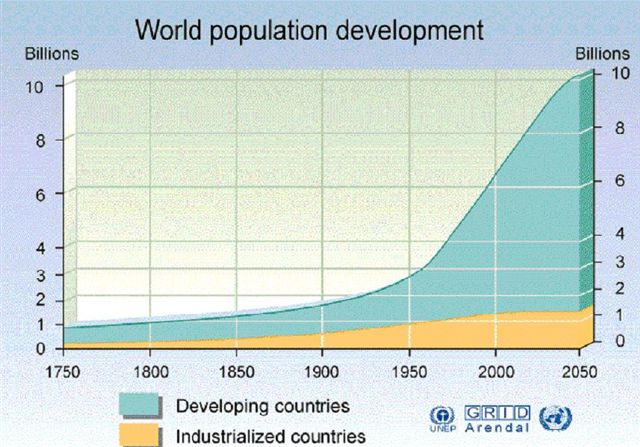
Demographic growth is the increase in the size of a population due to there being more births than deaths (a positive natural balance) and more migrants entering than leaving.
The population of the world is growing by 2.7 people per second (two people die per second). 95% of this growth is in the less developed world.
Today, approximately one in three people are under fifteen, which has huge implications for future population growth.
Subscribe to:
Posts (Atom)