
Showing posts with label Overpopulation. Show all posts
Showing posts with label Overpopulation. Show all posts
Sunday, February 1, 2015

Sunday, December 21, 2014
Questions on Hong Kong

Answer briefly the
following questions (10 minutes, one point per correct answer):
- Where is Hong Kong (be precise)?
- What are the three areas that make up Hong Kong called?
- What is a “metropolitan area”?
- What is a “megalopolis”?
- What is the name of the political party that runs China?
- Up to when was Hong Kong a British colony?
- About how many people live in Hong Kong?
- How many people live below the poverty line in Hong Kong?
- What does the Gini coefficient measure?
- What is the “HDI” and what was Hong Kong’s position in 2014?
Write an essay on ONE
of the following topics (20 minutes, 10 points):
- Explain why there were street protests in Hong Kong in 2014.
- Describe and explain the problems facing Hong Kong.
- List the reasons Hong Kong lacks space and explain what is being done to overcome the problem.
- Explain the fact that Hong Kong has become one of the leading global cities.
Sunday, October 12, 2014
Malala

Seventeen-year-old
Malala Yousafzai becomes the youngest Nobel Peace Prize winner for her work in
furthering education for children.
Questions:
- Who is Malala Yousafzai?
- What is the Nobel Peace Prize (list the people you know who have won it)?
- Why has Malala been awarded the 2014 Nobel Peace Prize?
- Do you think such a young person should have won this very prestigious prize?
- What does the charity A WORLD AT SCHOOL do (what does it have to do with Malala)?
- What are the Millennium Development Goals?
- Which of the Millennium Development Goals are Malala and A WORLD AT SCHOOL trying to reach?
- Do you think these two goals will be achieved (why/not)?
- How can YOU contribute to the actions of A WORLD AT SCHOOL?
- Who do you think should win next year's Nobel Peace Prize?
Tuesday, August 6, 2013

Sunday, July 28, 2013

Friday, July 5, 2013
11th July is World Population Day

Questions:
- What does "medium variant" mean?
- What is the difference between "estimated" and "projected"?
- Note the population of Africa in 1950, 2010, 2050, and 2100; how do you explain the rise in population of Africa?
- Note the population of Asia in 1950, 2010, 2050, and 2100; why is the population of Asia predicted to fall after 2050?
- Why is the population increase of Europe, the Americas, and Oceania so slow compared to Asia and Africa?

Questions:
- What are the missions of the United Nations Fund for Population Activities?
- What is the focus of World Population Day 2013?
- What percentage of women give birth by the age of 18 in developing countries?
- How do you explain this figure?
- What can be done about the problem?
Saturday, May 18, 2013

Monday, March 25, 2013
"Koyaanisqatsi" means, in the Hopi language, a (crazy) state of life that calls for another way of living

Click HERE to watch the video!
- Describe each image of the film, plus the accompanying sounds and music.
- Write down your thoughts, feelings, memories as you watch the film.
- List the different sections of the film.
- Choose a particular image from the documentary, describe it in detail, and explain what its significance is for you.
- What is this film "about" (how does the title relate to the contents of the documentary)?
- Is it a good movie, according to you (what is good/bad about it)?
- What have others said about it?
Monday, August 27, 2012


Saturday, August 4, 2012
Stephen Emmott's views on human population

Emmott
is a professor of
computing at Oxford University and head of Microsoft's Computational
Science Laboratory in Cambridge. His lab is devoted to finding new
techniques and ideas for solving key scientific problems. One of his
research groups works on small-scale issues including the make-up of
living cells and includes immunologists and neuroscientists. Another
group is focused on global problems including the carbon cycle and is
made up of plant biologists and marine ecologists.
The
global population
was 1 billion in 1800 and 4 billion in 1980.
It
will probably have grown to 10 billion by the end of this century.
The
demand for food
will have doubled by 2050.
Food
production already accounts for 30% of greenhouse gases – more than
manufacturing or transport.
More
food needs more land, especially when the food is meat.
More
fields mean fewer forests, which means even more carbon dioxide in
the atmosphere, which means an even less stable climate, which means
less reliable agriculture – witness the present grain crisis in the
US.
It
takes 3,000 litres of water to make a burger (the UK eats 10bn
burgers a year).
A
world population of 10 billion will need 960 new dams, each of them
the size of the world's largest in China's
Three Gorges, plus 15,000 nuclear power stations and/or 11m wind
farms.
The
great objective of intergovernmental action, such as it is, has been
to restrict the rise in average global temperature to no more than
2C, but a growing body of research suggests a warming by 6C is
becoming more and more likely.
The
world will become "a complete hellhole" riven by conflict,
famine, flood and drought.
Go
to a climate
change conference these days, and, as well as all the traditional
attendees, there will usually be a small detachment of the
forward-looking military.
What's
to be done?
Emmott
takes us through the ideas offered by "the rational optimists"
who believe that, faced with the species' near extinction, human
inventiveness will engineer a solution.
Desalination
plants, a new green revolution, seeding the oceans with iron filings
to absorb more CO2: all of these threaten to produce as many problems
as they solve.
He
believes the only answer is behavioural change.
We
need to have far fewer children and consume less.
How
much less?
A
lot less; two sheets of toilet paper rather than three, a Prius
instead of a Range Rover – that kind of sacrifice won't really do
it.
And
does he believe we're capable of making this necessarily far bigger
curb on our desires?
Not
really.
He
describes himself as a rational pessimist.
If
a large asteroid were on course to the Earth and we knew when and
where it would hit – say France in 2022 – then every government
would marshal its scientific resources to find ways of altering the
asteroid's path or mitigating its damage.
But
there is no asteroid.
The
problem is us.
Recently
he asked one of his younger academic colleagues what he thought could
be done.
"Teach
my son how to use a gun," said the colleague.
Text adapted from theguardian
Questions
Does Emmott think
the world is overpopulated?
Who are the
"rational optimists"
Emmott castigates?
Is
there a solution to overpopulation according to Emmott?
Sunday, July 29, 2012


Saturday, July 14, 2012

Wednesday, July 11, 2012

Wednesday, July 4, 2012
Demographic growth
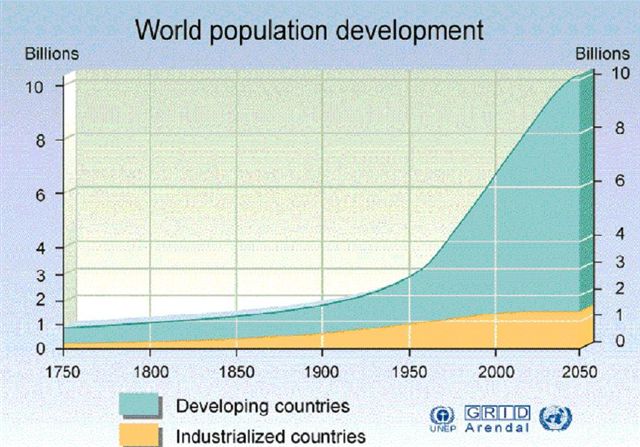
Demographic growth is the increase in the size of a population due to there being more births than deaths (a positive natural balance) and more migrants entering than leaving.
The population of the world is growing by 2.7 people per second (two people die per second). 95% of this growth is in the less developed world.
Today, approximately one in three people are under fifteen, which has huge implications for future population growth.
Monday, January 2, 2012

Wednesday, November 2, 2011
World population distribution

Factors that explain population distribution:
- relief
- water
- climate
- soil
- vegetation
- disease and pests
- natural resources
- economies
- communication networks
- political, social and cultural factors
Demographic transition model
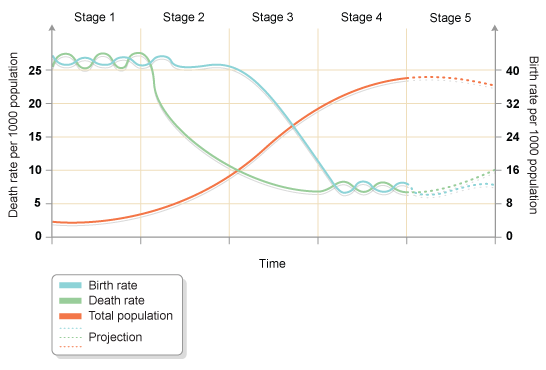
The demographic transition model explains how human populations go,
over a lengthy period of time, from a situation of demographic stability with
high birth and death rates, to a situation of demographic stability with low
birth and death rates.
Neolithic demographic revolution

The Neolithic demographic revolution started 10,000 years ago. Following the invention of agriculture and animal rearing, human groups settled (stopped being nomadic) and the population of the world started to slowly increase. Villages, then cities, and finally States were established; social groups became non-egalitarian and violent (wars).
"Settlement" means:
- the process of settling an area (exempli gratia: “the Irish settled in America”)
- a small community.
Population vocabulary

Population: a group of people within a particular place (country, region, town, etc.).
Population distribution: the way in which a population is spread over an area.
Population density: population per kilometer squared (for example: 78 people/km2).
Population density: population per kilometer squared (for example: 78 people/km2).
Subscribe to:
Posts (Atom)